

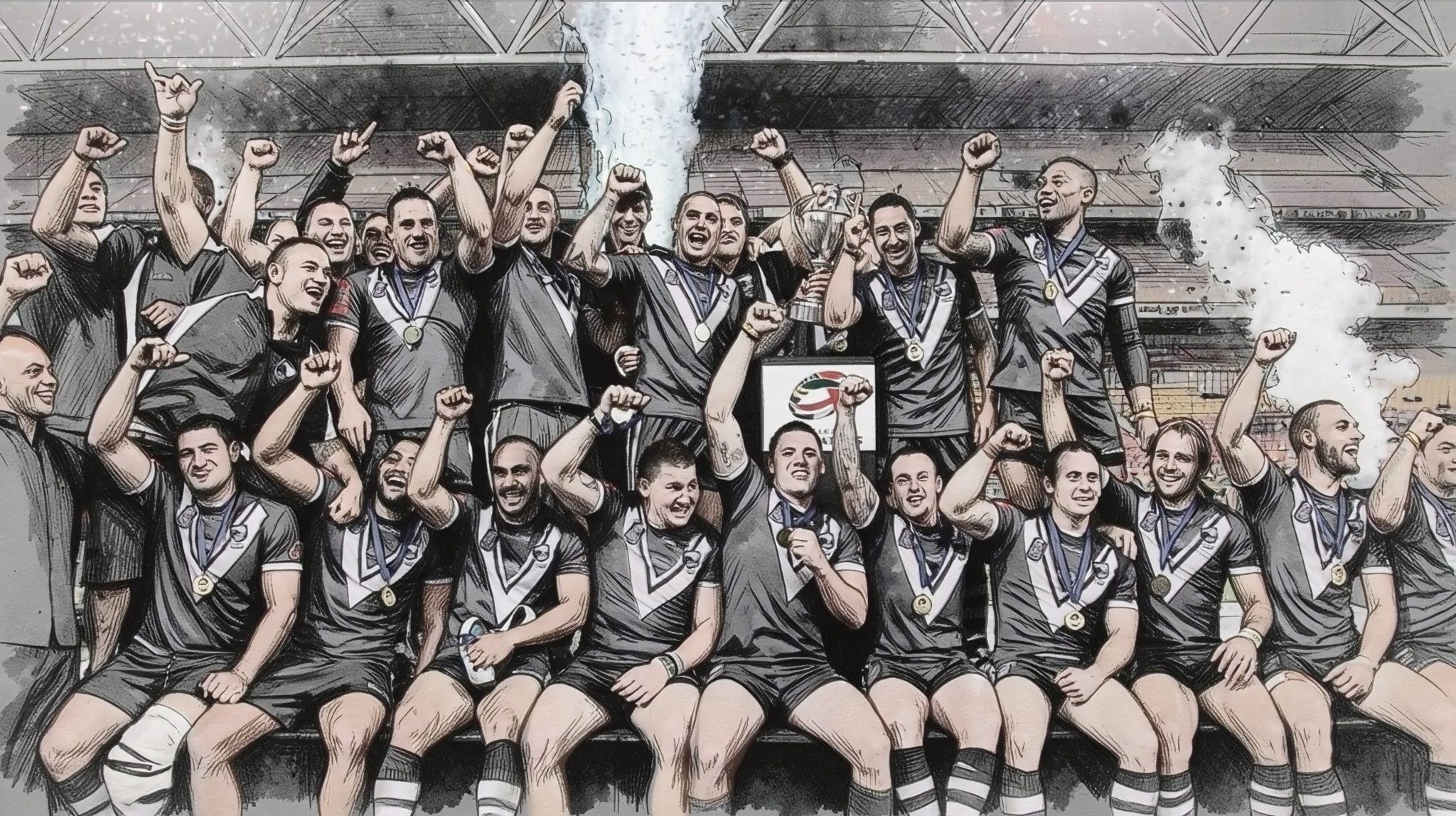
Rarely has New Zealand headed into a high-stakes showdown with Australia rated as strong a chance of victory as this Sunday’s Rugby League World Cup final.
If the Kiwis’ blistering form at the tournament, rampaging forward pack and a backline galvanised by the injection of Kalyn Ponga isn’t cause enough for sky-high optimism about knocking over the defending champs, the venue provides another psychological edge for the slight underdogs.
The Kiwis have won four of their last five matches at Suncorp Stadium — but their history of boilovers at the iconic Brisbane ground stretches back much further.
In fact, New Zealand’s history in Queensland’s biggest city is laced with significant victories over the past 118 years.
The famed All Golds played a maiden Test series against Australia en route home from Britain. Albert Baskerville, the chief organiser of the groundbreaking tour and regarded as one of the fathers of international rugby league, scored a try in the opening clash in Sydney but tragically died of pneumonia days later aboard the ship to Brisbane. The grieving New Zealand team regrouped to clinch the series with a 24-11 victory in front of 6,000 supporters at the Brisbane Exhibition Ground.
Australia returned the favour at the Brisbane Exhibition Ground in 1909, beating New Zealand 10-5.
The neigbouring nations did not play a Test in Brisbane again until 1948, when Newtown centre Len Smith (another tragic rugby league figure, for different reasons) led Australia to a 13-4 win over Pat Smith’s Kiwis to level a two-Test rubber at The Gabba.
The cricket ground hosted the teams again in 1952 — and Travers Harwick-led New Zealand carved out a famous 49-25 win over Clive Churchill’s Australian side, with legendary fullback Des White kicking a world record 11 goals.
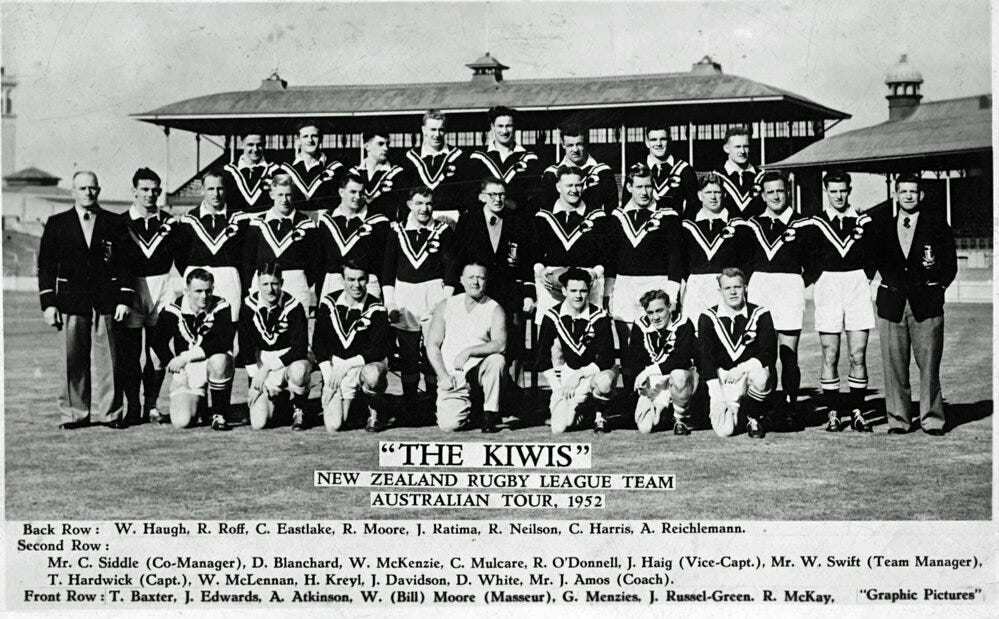
It remains New Zealand’s highest score against Australia and was at least a co-holder of the mark for the biggest winning margin until the 2023 Pacific Championships final.
Australia went on a run against New Zealand in Brisbane with victories at The Gabba in the 1956 Test series and during the 1957 World Cup, as well as a 38-10 romp back at the Exhibition Ground in 1959.
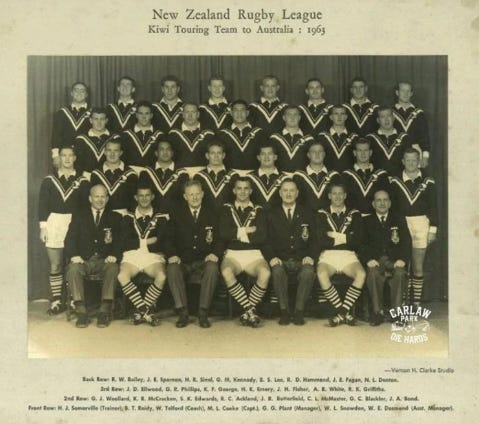
Having become the home of the Queensland Rugby League during the 1950s, Lang Park began hosting international matches in the 1960s — and New Zealand marked its first visit with a shock win.
A hat-trick to winger Brian Reidy saw the Kiwis overcome a halftime deficit and pull off a 16-13 result in the second Test of the 1963 series.
Lang Park was an unhappy hunting ground for the next two decades, however. Australia won five straight Tests against New Zealand at the venue from 1967-78, scoring more than 30 points in each.
A spirited 11-8 loss for the Ces Mountford-coached Kiwis in 1982 — with a young Wally Lewis named man of the match as Australia fought back from 6-2 down at halftime — was a more encouraging Brisbane foray that set up a golden era.
After 12 winless seasons against the mighty Australian side in all matches, New Zealand found iconic success during the 1980s on the hallowed turf of Lang Park, which was simultaneously proving a State of Origin graveyard for NSW.
Under the inspirational former Ōtāhuhu and Brisbane Norths coach Graham Lowe, New Zealand produced a boilover for the ages in 1983. The Graeme West-captained Kiwis employed roughhouse tactics to get the upper hand on their big-name rivals, eventually recording a 19-12 upset — their first over the green-and-golds since winning at Carlaw Park in 1971.
The match featured a brilliant try to Joe Ropati after a Dean Bell bust and a crunching try-saver on Mal Meninga by debutant Kiwis fullback Nicky Wright.
It was a platform for New Zealand’s home cleansweep of Great Britain in 1984 and the unforgettable 1985 series against Australia, which kicked off with a heartbreaking late 26-20 defeat at Lang Park but concluded with a watershed 18-0 loss at Carlaw Park.
Lewis and Brett Kenny toyed with the Kiwis as Australia sealed a three-nil whitewash 32-12 at Lang Park in 1986, but another Brisbane boilover was just around the corner.
New Zealand, with ‘Tank’ Gordon stepping into the gap left by Lowe’s controversial axing, fielded five players making just their second Test appearance in the one-off 1987 encounter. Australia — still basking in another undefeated Kangaroo Tour of Britain and France — was ambushed in its only international of 1987 and succumbed 13-6 after a scoreless second half. Unheralded New Zealand-based youngsters Kevin Iro, Gary Mercer and Ross Taylor spearheaded the win, along with experienced campaigners Dean Bell and skipper Hugh McGahan.
Australia redressed the balance with third-Test decider defeats of New Zealand in 1991 (40-12) and 1993 (16-4).
Renamed Suncorp Stadium in 1994 in a sponsorship arrangement, the ground played host to two Tests of the 1995 series. Brad Fittler’s Australian line-up — flush with newcomers with noSuper League-aligned players allowed — won 26-8 and 46-10 in Brisbane on the way to a three-nil sweep. A 30-12 spanking awaited Frank Endacott’s Kiwis during the 1998 post-season schedule.
Trans-Tasman footy returned to Brisbane in 2005, two years after the redeveloped Suncorp Stadium reopened as arguably the best rugby league facility in the world. The Darren Lockyer-led Kangaroos won the early-season Anzac Test 32-16 — though in a harbinger of River City encounters ahead, opposing five-eighth Benji Marshall was a shining light on debut in a beaten Kiwis outfit. Australia won the 2007 Anzac Test 30-6 in a match perhaps most significant — for New Zealand, at least — for Krisnan Inu earning the fullback spot after just one NRL game for Parramatta.
But the Kiwis cocked their legs and emphatically marked their territory at Suncorp Stadium over the next eight years.
New Zealand enjoyed its greatest-ever victory in the 2008 World Cup final at the ground. Trailing Australia 10-0 early on, the Kiwis clawed back and dominated the second half in a stunning 34-20 beatdown. Fullback Lance Hohaia scored a second-half double (inlcuding a critical penalty try) as opposing No.1, Kangaroos superstar Billy Slater, produced an infamous blunder to gift a try to Marshall.
Revered coach Wayne Bennett, who had just finished a 21-season tenure as Brisbane Broncos’ foundation coach, played a crucial role in bringing the Kangaroos undone as an assistant to 36-year-old Kiwis coach Stephen Kearney.
Australia gained some retribution by winning the 2009 Anzac Test at Suncorp Stadium 38-10 less than six months later, but New Zealand had another high-stakes ambush in store in 2010.
In a tight, fiery Four Nations final, the Kiwis stayed within touching distance of a heavily-favoured Kangaroos side, before captain Marshall briliantly set up a grandstand finish via an arcing grubber for winger Jason Nightingale to score. Eventual Golden Boot winner Marshall, Shaun Kenny-Dowall and Nightingale then combined to create a long-range match-winner in the dying stages, finished off by veteran halfback Nathan Fien for a euphoric 16-12 victory.
International rugby league’s heavyweights returned to Suncorp Stadium in 2014 for the Four Nations opener, where Shaun Johnson — who also went on to claim the Golden Boot — steered the Kiwis to a dominant 30-12 win over the Kangaroos. They would go on to clinch the title by defeating Australia in the Wellington final.
The 2015 Anzac Test was delayed by two days due to a massive downpour and extensive flooding in Brisbane. The extended build-up played into the Kiwis hands: Kearney’s charges recovered from a slow start to steamroll Australia 26-12 — New Zealand’s first mid-season win over the green-and-golds in 17 years.
Manu Vatuvei’s barnstorming two-try display earned the newly-struck Charles Savory Medal as player of the match.
The 2026 World Cup decider ends an 11-year trans-Tasman Test drought at Suncorp Stadium.