WARRIORS 1995-2025 BOOK CHAPTER MENU
The New Zealand-wide fervour for the Auckland Warriors’ premiership entry was graphically illustrated during the pre-season trials. A record 12,811 spectators packed Christchurch’s Addington Showgrounds to see the Warriors beat the Canterbury provincial team 26-12; subsequent games against provincial opposition in Palmerston North, Kaikohe and Auckland drew massive interest; and a 12,000-strong Carlaw Park throng made a deafening roar throughout a 23-16 win over Canberra.
A relatively strong squad embarked on the Warriors’ first official competitive foray in early-February, the Sydney-hosted World Sevens. They beat Canberra but lost to a New Zealand combination, before being tipped out of the second-tier Trophy quarter-finals by Sydney Tigers.
Next up was the Toohey’s Challenge pre-season knockout – a more accurate litmus test of how the fledgling outfit was shaping up. The Warriors, fielding 16 of the 17 players who would feature in their premiership debut, were edged by heavyweights North Sydney at Parramatta Stadium. The 14-12 loss was encouraging, particularly given linchpin Greg Alexander sat out the match.
The club sold over 13,000 season tickets before the season kicked off. The Warriors’ 1995 premiership opener against the Brisbane Broncos at Ericsson Stadium was the hottest ticket in town. Saturation coverage across every media platform. Arguably only the America’s Cup challenges of 1987 and 1995, the 2011 Rugby World Cup and 2015 Cricket World Cup have come close to matching it in the pantheon of New Zealand sports since. “It was bigger than Ben Hur. It went even further than my expectations,” Dean Bell says. “Coming back to Auckland to lead the side out in that first-ever season was a massive honour. I knew it was going to be a big deal, but there was no way I thought it was going to be as big as it turned out. To say I was nervous before the first game was an understatement, because it was going into the unknown.”
Gains: Greg Alexander (Penrith), Ricky Andrew (Glenora), Simon Angell (Hornby), Dean Bell (Wigan), Dennis Betts (Wigan), Phil Blake (St George), Frano Botica (Wigan), Mike Dorreen (Addington), Jason Duff (Papanui), Logan Edwards (Marist-Western Suburbs), Peter Edwards (Upper Hutt), Syd Eru (Upper Hutt), David Fatialofa (Marist), Bryan Henare (Otahuhu), Gavin Hill (Canterbury), Sean Hoppe (North Sydney), Stacey Jones (City-Pt Chevalier), Takofe Kalauta (Papanui), Stephen Kearney (Western Suburbs), Charlie Kennedy (Omahu), Solomon Kiri (Mangere East), John Kirwan (Auckland rugby union), Usa Lafaele (Otara), Aaron Lester (Ellerslie), Peter Lima (Otahuhu), Jason Mackie (Takahiwai), Des Maea (Otahuhu), Brady Malam (Glenora), Gus Malietoa-Brown (Papakura), Duane Mann (Warrington), Dallas Mead (Bluff), Martin Moana (Huntly South), David Murray (Ellerslie), Gene Ngamu (South Sydney), Bruce Nilsen (Bluff), Meti Noovao (Otahuhu), Hitro Okesene (Manukau), Julian O’Neill (Marist), Andy Platt (Wigan), Willie Poching (Northcote), Paul Rauhihi (Northcote), Tea Ropati (St Helens), Se’e Solomona (Oldham), Paul Staladi (Mt Albert), Logan Swann (Ellerslie), Willie Swann (Marist), Whetu Taewa (Halswell), Tony Tatupu (Mt Albert), Manoa Thompson (Western Suburbs), Tony Tuimavave (Northcote), Joe Vagana (Richmond), Nigel Vagana (Richmond), Frank Watene (Otahuhu)
The line-up for the historic March 10 encounter was: Phil Blake, Sean Hoppe, Dean Bell (c), Manoa Thompson, Whetu Taewa, Gene Ngamu, Greg Alexander, Gavin Hill, Duane Mann, Hitro Okesene, Stephen Kearney, Tony Tatupu, Tony Tuimavave. Interchange: Se’e Solomona, Tea Ropati, Jason Mackie, Martin Moana.
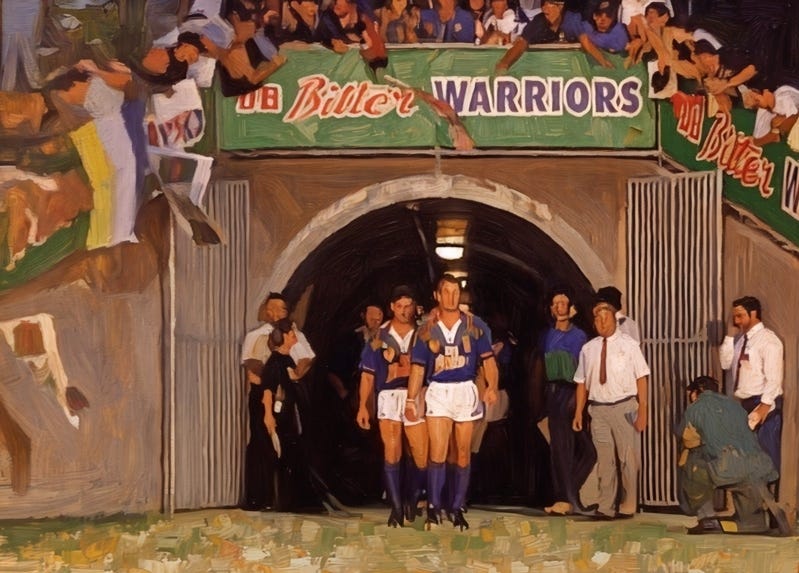
WARRIORS’ GREATEST GAMES – ROUND 1, 1995: BRISBANE BRONCOS 25 DEFEATED AUCKLAND WARRIORS 22 AT ERICSSON STADIUM The Auckland Warriors fulfilled the skyscraper-high expectations placed on them ahead of the club’s Australian premiership debut, but they landed just short of a dream start in a pulsating 25-22 loss to the Allan Langer-inspired Brisbane Broncos. A sell-out crowd of 29,220 had Ericsson Stadium bursting at the seams and the venue erupted as captain Dean Bell and the Warriors emerged from the tunnel and strode onto the field flanked by flames. But the Broncos made an ominous start through early tries to Willie Carne and Chris Johns. The Warriors struck in the 21st minute with a memorable maiden try, a 40-metre movement featuring superb offloads from Manoa Thompson and Whetu Taewa and finished off by fullback Phil Blake. Bell put Sean Hoppe over for a leveller soon afterwards and the Warriors stormed to a 22-10 lead with tries either side of halftime to Tony Tatupu – a blockbusting solo effort – and Tea Ropati. The incomparable Langer squared up the scoreboard with tries in the 54th and 61st minutes, however, and Julian O’Neill booted a penalty goal and a field goal to give the Broncos a three-point buffer as the Warriors frequently found themselves on the wrong end of referee Bill Harrigan’s whistle. The Broncos withstood a goal-line assault from the valiant Warriors in the dying seconds, hanging on to win an instant classic. Bell and Stephen Kearney were lauded as Auckland’s standout performers. The Frank Endacott-coached reserve grade side created history courtesy of a 36-14 win over their Broncos counterparts earlier in the evening, with Syd Eru scoring two tries and Stacey Jones kicking six goals.
“I think I’ve met every person that was in that 30,000 crowd – I still bump into so many people that say they were at that game,” laughs Bell, who is forever enshrined in the club’s history as Warrior No.1. “It was a moment in history that the game in New Zealand had never seen and has never seen since. Rugby league had finally arrived. That first game was so important because of all the hype, the marketing, the promotional stuff. It could have really gone the other way if we hadn’t turned up. It laid a good platform.”
Bouquets for the intrepid debut performance, and the occasion, piled up. The night has deservedly attained mythical status as one of the nation’s most iconic sporting events. “I’ve always said that game is in the top half-dozen games that I’ve played in. It will always be one of the most enjoyable games in terms of expectation, atmosphere and general feeling,” Alexander says. But the match also proved symbolic of the Warriors’ initial season and many more of their first 25 campaigns: slow out of the blocks, a stirring revival in which they looked like world-beaters, and a late collapse that left everyone agonising over what might have been. An exhilarating ride…but ultimately a big tease.
Veteran New Zealand league journalist and author John Coffey recalls a fellow scribe, a non-’leaguie’, declaring post-match that the Warriors would not lose another game in ‘95. But any misconceptions the media, fans or players had about the difficulty of competing week-to-week in the Australian premiership were torched in a Steelers Stadium furnace eight days later. The mercury soared past 30 degrees and the Warriors were playing catch-up from the outset in a 40-28 loss to Illawarra, despite Blake and Hoppe bagging doubles. “I just remember those big hot, cotton jerseys,” Alexander winces. “Our big blokes melted in the sun.”
The loss garnered a reputation as poor travellers the Warriors found hard to shake – not aided by heavy losses at North Sydney (48-10) and Newcastle (48-6) by mid-May. But there were few complaints about the side’s early form at home. The Warriors carved out their first win via a second-half blitz against visiting Western Suburbs in Round 3, turning a tenuous 18-12 halftime lead into a 46-12 victory. Blake scorched over for four tries, while Gene Ngamu was man-of-the-match with Hitro Okesene not far behind. The landmark result was destined to be shrouded in infamy, however.
FAST FACT: The well-travelled Blake – who had played only 17 of his 232 games prior to 1995 at fullback – scored nine tries in the opening four rounds, moving into the top 10 on the all-time premiership tryscoring register.
Points stripped after replacement debacle
Elation over the Warriors’ emphatic win over the Magpies turned to devastation when it was revealed they had used five interchange players – one more than the maximum allowed. Twenty-year-old prop Joe Vagana became the unwitting fifth replacement when Willie Poching, who had only entered the fray a few minutes earlier, went to the blood bin in the 69th minute. The error initially went undetected, until TVNZ reporters reviewed the footage and contacted the Australian Rugby League for comment. Despite having the result sewn up at 34-12 when the bench snafu occurred, the ARL had no option but to dock the Warriors of their first premiership points. The blame fell squarely at the feet of John Monie and his coaching staff - The penalty would prove incredibly costly.
As the Warriors were getting towelled up by the Bears in Round 4, an infinitely more serious and far-reaching battle was unfolding off the field. The Super League War hit the code like a thousand shoulder-charges, with News Limited launching widespread signing raids on elite players to play in a rival competition.
Media tycoon Rupert Murdoch, the owner of News Limited, had formed Foxtel in a joint venture with Telstra and viewed rugby league – via a streamlined Super League competition made up of privately-owned clubs – as the main vehicle to carry his proposed pay-TV juggernaut. Archrival Kerry Packer, through his controlling interest in Channel Nine, had purchased the free-to-air and any future pay-TV rights to the Australian premiership in 1993. Rumblings about a News Limited-run breakaway competition began in early-1994 and had become increasingly ominous by the end of the year. After reaching an impasse with the Australian Rugby League and Packer in early-1995, Super League made their move to take the game over by force.
Glamour clubs Canterbury, Brisbane and Canberra were the first targeted, signing virtually en masse. Players, coaches and chief executives from Cronulla, Penrith and expansion teams Auckland, North Queensland and the Western Reds – and the clubs themselves – soon followed in turning their backs on the ARL establishment to hitch their wagons to Super League’s star. The ARL scrambled to secure the remaining 12 clubs and their players, but the game entered three years of bitter division, courtroom battles and astronomical spending. Rugby league would never be the same again.
John Monie and Warriors CEO Ian Robson had met with Super League bosses in 1994 and signalled their interest in joining the rebel movement. The Warriors players collectively signed with Super League during the April contract spree and revelled in their newfound riches. But the club’s board was split: Chairman Peter McLeod and the majority of the Auckland Rugby League faction – grateful to the Ken Arthurson- and John Quayle-led regime for granting their entry to the premiership – were loyal to the Australian Rugby League. But their hands were tied. The New Zealand Rugby League also controversially sided with Super League.
English superstar Denis Betts, who was still weeks away from joining the Warriors from Wigan, signed with Super League for a reported $700,000 per season (“Rupert Murdoch is the nicest man I have never met,” Betts later quipped upon his arrival at Auckland International Airport). New Zealand fullback Matthew Ridge defied his ARL-loyal Manly club and signed for a reported $650,000 in a move that would eventually deliver him to the Warriors. Fringe first-graders and rookies were suddenly on rep star money. Every player in the competition received a sign-on bonus and a salary increase probably beyond their wildest dreams.
Amid the chaos, the footy continued. In Round 5, the Sea Eagles – coached by Australian Test coach and ARL figurehead Bob Fulton – arrived in Auckland for a blockbuster clash. Ridge’s five-from-five with the boot was crucial in the visitors’ high-quality 26-14 win. Hoppe’s two-try display for the Warriors, who hung in at 14-all with 14 minutes left, drew acclaim.
But with five games down and no competition points in the bank, the Warriors badly needed results. They belatedly got off the mark with a sizzling 38-12 revenge result against the Steelers (with Hoppe bagging another double) in front of 32,174 fans at Ericsson Stadium, which remains a record for the ground. The breakthrough started a run that garnered 11 wins in 13 games, while they snared a maiden victory on Australian soil in Round 7 with a 40-4 thumping of strugglers Parramatta. Ngamu starred again, while All Blacks legend John Kirwan set up two tries in his starting debut.
Kirwan – arguably New Zealand’s greatest-ever rugby union winger with 35 tries in 63 Tests – resisted the Warriors’ initial overtures in late-1994. But he had a change of heart and signed with the club in March, embarking on a five-week training crash course before taking the field. The Warriors’ acquisition of the 30-year-old was derided as a PR stunt. And while Kirwan’s arrival certainly delivered publicity-wise, he was competent on the flank and a hugely positive off-field influence.
Warriors play to the beat of their own drums
The vocal crowds were not the only aspect of playing in Auckland that drove visiting teams to distraction – Sydney City Roosters coach Phil Gould condemned the Polynesian drummers who became early Ericsson Stadium fixtures after his side’s 26-22 loss. “They are unnecessary and unsportsmanlike and their use should be looked at immediately,” Gould griped. Counterpart Monie had no intention of the Warriors becoming more accommodating hosts: “They add a new dimension to the competition. It’s Auckland, it’s New Zealand, it’s the Pacific Islands and we’ve got every right to use it.” Dean Bell scored two tries in the win over the Roosters but missed the next three games with injury.
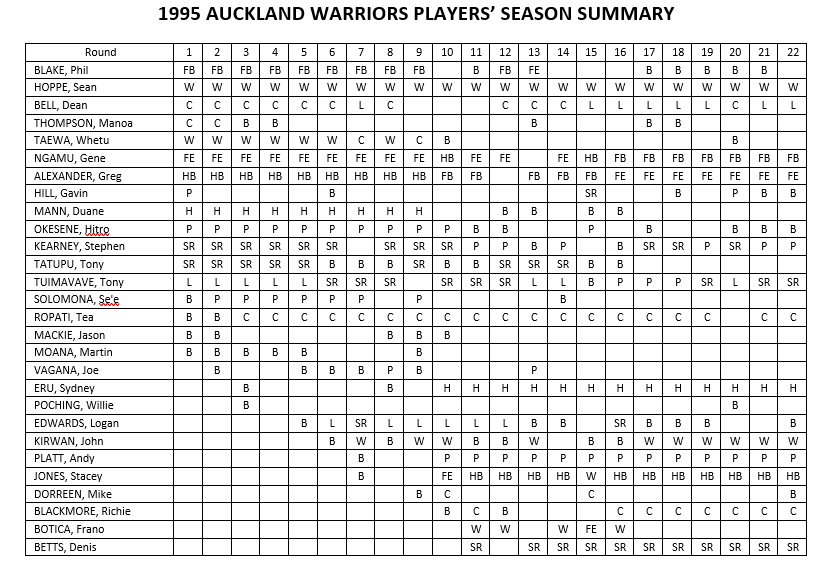
Monie lost patience following the 42-point defeat to the Knights. Blake was dropped to accommodate teenage half Stacey Jones, with Alexander shifting to fullback. Incumbent Kiwis captain Duane Mann was dropped in favour of livewire Wellington rake Syd Eru. Taewa, Solomona, Moana and Mackie were phased out. The axe-swinging coincided with champion back-rower Betts, New Zealand Test centre Richie Blackmore and superboot Frano Botica arriving from England. Great Britain stalwart Andy Platt also belatedly took up residence in the front-row, though he was still hampered by the knee problems that kept him out of the early rounds.
Meanwhile, Ruben Wiki returned to the field for Canberra, having won his case against the Warriors in the Supreme Court. The Warriors’ failure to offer the boom centre an upgraded deal and some substandard record-keeping from Robson ultimately made it easier for the Court to find in favour of Wiki and the Raiders.
Keeping up with Jones
The Warriors watched their future dart, probe and chip-kick all over Shark Park in Round 10 as Stacey Jones produced one of the most memorable starting debuts of the 1990s just a week after his 19th birthday. The diminutive half made a tryscoring cameo off the bench against Parramatta but really put his class and confidence on show against high-flying Cronulla. Troubling the Sharks all afternoon with his instinctive running game and deft boot, Jones stepped up to kick a deadlock-breaking field goal in the 77th minute field goal before a late Hitro Okesene try sealed a 23-18 victory – one of the ‘95 Warriors’ best. Jones played the next 99 games in first grade in succession. “You can tell he’s something a bit special,” gushed Greg Alexander, who moved out of the halves to allow Jones’ promotion. “He’s been playing real well in reserve grade but he went up a level around better players. That’s the sign of a class player.”
Fresh off winning the Man of Steel as the English competition’s best player, Betts gave every indication he had brought that form Down Under with a two-try, man-of-the-match performance on club debut as the Warriors whipped the Sydney Tigers 36-12. Wigan teammate and former All Black Botica kicked six goals in his first Warriors outing. But Betts’ top-shelf performances would prove frustratingly infrequent in three seasons with the club, while Botica broke his leg in just his fifth game. Despite signing for two years, Botica returned to England with Castleford at the end of 1995.
Kiwis great Gary Freeman outplayed Jones in Penrith’s 34-16 win at Ericsson Stadium to temporarily quell suggestions the rookie sensation was set usurp him in the New Zealand Test side. Ngamu, Hoppe, Kearney, Blackmore, Tatupu, Logan Edwards, and debutants Syd Eru – who squeezed 1994 skipper Mann out of the No.9 jumper – and Tuimavave all featured during the Frank Endacott-coached Kiwis’ mid-season campaign, a scrappy series win over France and a 3-0 whitewash at the hands of an Australian team made up solely of ARL-loyal players.
But the Warriors were unhindered by the international workload, embarking on a six-match winning streak (albeit exclusively against clubs that missed the finals) – including a cleansweep of fellow newcomers the Reds, Crushers and Cowboys – that lifted them to sixth on the ladder. Tea Ropati notched a hat-trick in a 44-16 beatdown of the Gold Coast Seagulls. Monie moved Ngamu to fullback and Alexander to five-eighth as he tinkered to find the Warriors’ best combination. He also shifted Bell to lock for the run home, bolstering the Warriors in the middle of the park. One of only three players to feature in the first 16 rounds, dynamic back-rower Tatupu missed the last six weeks of the season through injury.
The original Warriors cult hero
Playing 22 first grade games over three seasons isn’t the traditional path to club legend status. But such was Hitro Okesene’s foundation-era impact and distinctive playing style, his is routinely the first name recalled by the Warriors’ ‘day one’ supporters. Okesene’s only taste of football outside the Auckland club cocoon was a few off-seasons with second-tier English outfit Carlisle, but he earned a modest Warriors contract and a Kiwis call-up on the back of his 1994 Lion Red Cup efforts for Counties-Manukau. The nuggetty hooker-cum-prop’s fearsome defence and full-throttle, head-down charges, wild black mullet and a name closely resembling nitro-glycerine – delightfully apt, given his explosive performances – rendered Okesene a cult hero for the ages. “I only lived down the road from Penrose then. I was staying in my parents’ garage in Mangere when that first game [against the Broncos] was played,” Okesene later told Rugby League Week. “To tell you the truth, I was looking at these guys that I’d watched on TV, and it was just cool to get to know them. I was only 95 kilos – these days the halfbacks weigh that much. But I put my body and soul into every tackle and I didn’t see big names running at me with the ball...I just saw bodies. I loved to shoulder-charge and belt blokes in tackles.” Despite playing 17 games in 1995 and featuring in the Kiwis’ World Cup campaign, Okesene made just four top-grade appearances in 1996-97 and played out his career in England – but he retains a cherished place in Warriors folklore as one of their all-time fan favourites.
A gentle schedule against a string of also-rans proved the worst possible lead-in to a crunch clash with red-hot St George in Round 19. The Warriors had no answer for destructive Dragons back-rower Gorden Tallis in a 47-14 loss – their biggest at home until 2004. Jones produced arguably the finest individual performance by a Warriors player in 1995, masterminding a stunning 29-8 victory over the Bulldogs in Sydney. Former Junior Kiwi Willie Poching enjoyed the highlight of his brief Warriors career, scoring a barnstorming try and setting up fellow interchange Blake’s second four-pointer in a memorable, match-sealing cameo. The Bulldogs went on to lift the last Winfield Cup trophy without losing another game.
The long-awaited grudge match with Wiki’s Raiders came in the penultimate round and the Warriors’ last home game of the season. Hoppe, punted by Canberra two years earlier for signing with Auckland, scored the first try as 29,500 fans willed the home side to an upset, but a Laurie Daley double led the Raiders to a hard-earned 15-8 win.
The Warriors clung to eighth as they approached an Everest-like final-round assignment in Brisbane. They needed a win over the Broncos or an unlikely Bears loss to the lowly Seagulls to feature in the finals. The first part of that equation was quashed by halftime at ANZ Stadium as the Broncos blazed to a 28-0 lead. Steve Renouf finished with four tries in a 44-6 rout. “There were good signs against Canberra that we were becoming the team we wanted to be,” Bell recalls. “But Brisbane taught us a lesson. The speed they played the game was a step ahead of us. Great players, fast track – there wasn’t much we could do that day.”
Norths snatched a late draw on the Gold Coast to move level with the Warriors on 24 points and take eighth spot on for-and-against (the Roosters’ big win over the Tigers bumped the Warriors down to 10th). Almost inevitably, the shambolic and gut-wrenching two-point penalty from their win over the Magpies for fielding an illegal replacement had cost the Warriors a place in the playoffs. The Warriors were immediately recognised among the competition’s entertainers, but defensive resolve and stiffening up the forward pack were at the top of Monie’s summer to-do list.
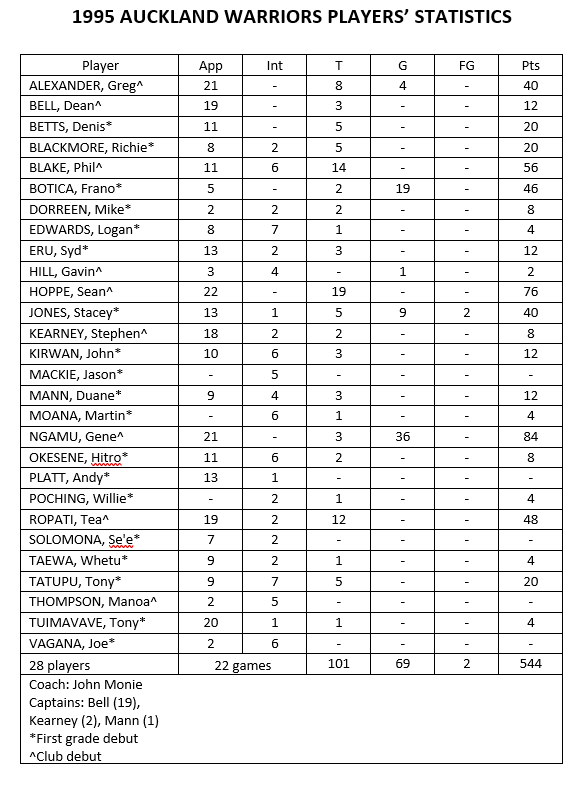
FAST FACT: The Warriors’ tally of 544 points was more than any team that missed the finals in the first 88 years of the premiership. Their 24.73 points per game remains the second-best regular-season average in the club’s history.
Ropati was a surprise winner of the Warriors’ inaugural Player of the Year award – most tipped Bell for the gong – but the silky centre’s performances were certainly deserving of recognition, missing just one game and scoring 12 tries. Hoppe finished third in the premiership with 19 tries after crossing seven times in the last eight rounds and was named Dally M Winger of the Year. Kearney and Tuimavave were the leading lights in the engine-room, while Cantabrian Logan Edwards was an unheralded but valuable contributor. Backed up in their maiden first-grade campaigns by Alexander’s class and experience, key-position trio Jones, Ngamu and Eru loomed as the club’s future.
Bell’s impact was immense. Risking the legacy created with a stellar Kiwis career and a decorated stint at Wigan, the 33-year-old emphatically proved he could still foot it in the world’s toughest competition. “It was such an honour to be part of,” he reflects. “If I could script the best way for me to finish my career, that was it – and I’m pretty hard to please.” Bell had a swansong with Leeds in 1996.
The recruitment of All Blacks duo Marc Ellis and Mark Carter titillated the masses, but the fact it came at the expense of Kiwis reps such as Taewa and Edwards – who joined the Cowboys and mooted Super League club the Hunter Mariners respectively – troubled the rugby league purists. The impending arrival of Ridge and fellow Super League-aligned Sea Eagle Awen Guttenbeil received more widespread approval.
Frank Endacott’s reserve grade side scraped into eighth on for-and-against. Fielding eight Kiwi internationals – including captain Mann – and the likes of Blake and Thompson, they were eliminated 14-8 by the Panthers in week one of the finals. The John Ackland-coached Warriors Colts, who were led by Meti Noovao and boasted future first-grade stars Nigel Vagana, Logan Swann and Anthony Swann, went down to North Harbour in the Lion Red Cup grand final.
Taking on the world
Endacott took a New Zealand squad containing seven Warriors – Kearney, Jones, Blackmore, Hoppe, Ngamu, Okesene and Eru – to the Centenary World Cup in England. Jones sensationally unseated incumbent captain Gary Freeman at halfback for the tournament-opener against Mann-led Tonga, in which the Kiwis got out of jail 25-24. The Kiwis’ campaign ended with a gallant extra-time loss to Australia. After playing for New Zealand mid-season, Tuimavave and Tatupu represented Graham Lowe-coached Western Samoa, alongside clubmates Ropati, Poching, Solomona, Joe Vagana and Willie Swann. Platt and captain Betts featured in England’s charge to the final, where Australia – sans Super League signees – prevailed 16-8.
By almost every metric, the Auckland Warriors’ first season received a solid pass mark. But behind the scenes there was deep concern after the club posted a reported $64,000 profit from turnover of $15 million – with CEO Robson’s largesse and mismanagement largely blamed. A public relations Svengali, Robson’s penchant for making decisions without board approval was also causing massive ructions. Meanwhile, the Auckland Rugby League clubs rejected Super League proponent Sir Roger Douglas’ bid for re-election on the board in favour of Peter McLeod, who had been succeeded as chairman by fellow Australian Rugby League sympathiser Gerald Ryan. But any push to step away from Super League would prove unsuccessful – the Warriors, with their players and coach banking News Limited cheques, were already in too deep.
From a public perspective, the post-1995 glow would represent a highwater mark for the Warriors – on and off the field – until 2001 as the club lurched from setback to disaster to upheaval in the five years that followed.
AUCKLAND WARRIORS - 1995 ARL PREMIERSHIP SCORES
RD 1 (H) – Broncos 25 d Warriors 22 (Blake, Hoppe, Tatupu, Ropati tries; Ngamu 3 goals)
RD 2 (A) – Steelers 40 d Warriors 28 (Blake 2, Hoppe 2, Ropati tries; Ngamu 4 goals)
RD 3 (H) – Warriors 46 (Blake 4, Ropati, Alexander, Kearney, Ngamu tries; Ngamu 7 goals) d Magpies 12*
RD 4 (A) – Bears 48 d Warriors 10 (Blake 2 tries; Ngamu goal)
RD 5 (H) – Sea Eagles 26 d Warriors 14 (Hoppe 2, Moana tries; Ngamu goal)
RD 6 (H) – Warriors 38 (Hoppe 2, Bell, Ropati, Alexander, Mann, Taewa tries; Ngamu 5 goals) d Steelers 12
RD 7 (A) – Warriors 40 (Jones, Tatupu, Mann, Ngamu, Ropati, Hoppe, Blake tries; Ngamu 4, Alexander goals) d Eels 4
RD 8 (H) – Warriors 26 (Bell 2, Mann, Tatupu, Ropati tries; Ngamu 3 goals) d Roosters 22
RD 9 (A) – Knights 48 d Warriors 6 (Blake try; Ngamu goal)
RD 10 (A) – Warriors 23 (Hoppe 2, Dorreen, Kirwan, Okesene tries; Ngmau goal; Jones field goal) d Sharks 18
RD 11 (H) – Warriors 36 (Betts 2, Hoppe 2, Ropati, Jones tries; Botica 6 goals) d Tigers 12
RD 12 (H) – Panthers 34 d Warriors 16 (Blackmore 2, Ropati, Okesene tries)
RD 13 (A) – Warriors 16 (Jones, Tuimavave, Tatupu tries; Jones 2 goals) d Magpies 12
RD 14 (A) – Warriors 38 (Eru 2, Edwards, Betts, Tatupu, Botica, Alexander tries; Botica 5 goals) d Rabbitohs 20
RD 15 (H) – Warriors 44 (Ropati 3, Dorreen, Alexander, Hoppe, Kirwan, Botica tries; Botica 6 goals) d Seagulls 16
RD 16 (H) – Warriors 34 (Eru, Jones, Betts, Alexander, Ropati, Hoppe tries; Jones 3, Botica 2 goals) d Reds 10
RD 17 (A) – Warriors 22 (Hoppe 2, Blackmore, Blake tries; Jones 3 goals) d Crushers 10
RD 18 (A) – Warriors 28 (Alexander 2, Betts, Kirwan, Hoppe, Blackmore tries; Ngamu 2 goals) d Cowboys 10
RD 19 (H) – Dragons 47 d Warriors 14 (Hoppe, Blackmore, Jones tries; Alexander goal)
RD 20 (A) – Warriors 29 (Blake 2, Alexander, Kearney, Poching tries; Alexander 2, Hill, Ngamu goals; Jones field goal) d Bulldogs 8
RD 21 (H) – Raiders 15 d Warriors 8 (Hoppe try; Ngamu 2 goals)
RD 22 (A) – Broncos 44 d Warriors 6 (Ngamu try; Ngamu goal)
*Warriors stripped of two competition points for fielding illegal fifth replacement
Won 13, Lost 9 – Points For: 544 Points Against: 493 – Ladder Position: 10th (of 20)