

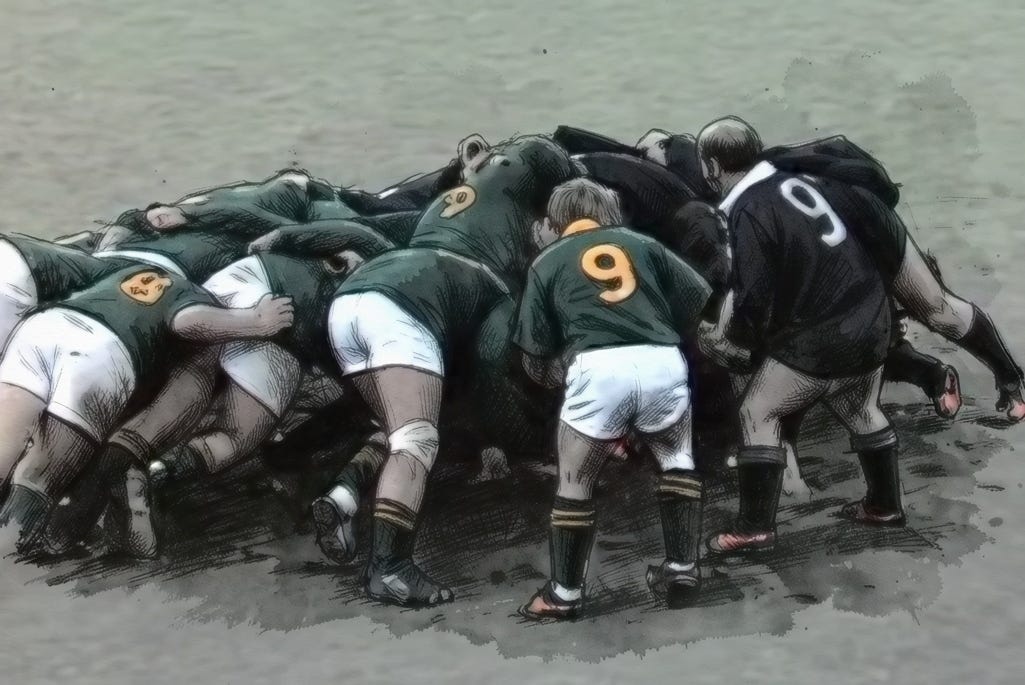
The All Blacks’ greatest triumphs were forged against the Springboks, but the compromises required left some of the most regrettable stains in New Zealand rugby’s rich narrative.
An obsession with proving the All Blacks’ mettle against this formidable foe saw the New Zealand Rugby Football Union contravene its values – at the expense of Māori players – for almost 40 years, genuflecting to South Africa’s laws of racial segregation and subordination.
By the time the NZRFU belatedly held its ground and refused to send teams to the Republic without non-white players, it found that was not enough for a multiplying sector of the New Zealand public repulsed by apartheid – and consequently our ongoing sporting relations with South Africa.
Epic Tests and tours were staged against the backdrop of protests, civil unrest and violent clashes unprecedented in 20th century New Zealand. The pro-rugby, keep-sport-and-politics-separate brigade was as unwavering, passionate and outspoken as the vociferous anti-tour mob. Players made career-altering stands. General elections were won and lost on governments’ interference (or lack thereof) in the complex, multi-layered issue. Countries boycotted Olympic Games. Families and workplaces were divided, in some cases irreparably.
All for the sake of chasing a piece of leather around the football fields of Auckland, Wellington, Christchurch, Pretoria, Cape Town and Johannesburg. The debate over whether the ongoing rugby contact, or the wins achieved by anti-tour campaigners, or both, helped facilitate change – and whether it was the game’s cross to bear in the first place – will never be settled.
But in the Springboks, the All Blacks discovered an opponent that mirrored the qualities they prided themselves on and the attributes the rest of the rugby world had placed New Zealand on a pedestal for: tough, physical, aggressive, fearless, consistent and near-unbeatable on home soil. Losses to South Africa were not subject to the same level of critical dissection as All Black defeats to other nations; due praise was lavished on the victorious Springboks.
Facing the Springboks was viewed as the ultimate challenge. Touring South Africa was a career highlight – and a Test series victory there eluded the All Blacks for 68 years, with high-altitude venues and contentious officiating adding to the difficult in toppling an awesome opponent. Reputations and legacies were carved out or eroded based on a player’s ability to perform in the game’s hottest cauldron.
The fall of apartheid allowed the adversaries to resume their on-field combat unfettered, setting the scene for some of the era’s most memorable encounters. After a minimum of four years between series previously, the advent of professional rugby saw the All Blacks and Springboks square off in 26 consecutive seasons until the pandemic, and South Africa’s abrupt withdrawal from the Rugby Championship, intervened in 2020.
EXCLUSION
Though a New Zealand Army team had toured South Africa in 1919 after World War I ended, the Springboks arrived on our shores in 1921 a mysterious, unknown quantity. The All Blacks had not assembled since 1914 due to the war; the Springboks’ last Test match was a year earlier.
Rabid interest followed the tour, which included Canterbury’s famous 6-4 victory over the visitors at Lancaster Park, and a deadlocked Test series after the All Blacks and Springboks played out a gripping scoreless draw in the deciding third match. But the historic sojourn was tainted by South Africa’s clash with New Zealand Māori in Napier.
A Māori player later told R.H. Chester and N.A.C. McMillan, the authors of the 1990 book The Visitors, Afrikaner members of the South African team had turned their backs on a poi and singing performance by a group of Māori girls. “We were seething with anger as we waited for the kick-off,” the player recalled. The Springboks, who also allegedly refused to shake their opponents’ hands, won an ill-tempered, controversial affair 9-8 – but the acrimony only increased post-match.
A message by a Mr Blackett to South African newspapers contained the following: ‘Most unfortunate match ever played … Bad enough having play team officially designated New Zealand natives but spectacle thousands Europeans frantically cheering on band of coloured men to defeat members of own race was too much for Springboks who frankly disgusted.’ The cable was leaked by a post office employee to the Napier Daily Telegraph, which published the contents.
Newspaper columns, along with public condemnation from prominent Māori such as Dr Peter Buck (Te Rangi Hīroa), reflected New Zealanders’ prevailing outrage. The tourists distanced themselves from Blackett and the offensive remarks, but an ominous tone had been set for the nations’ rugby relationship.
The rivals played just four Tests apiece between the ’21 Springboks tour and the trail-blazing All Blacks tour of South Africa seven years later. South Africa went unbeaten in a four-match home series against the British Lions in 1924, shortly before the New Zealand ‘Invincibles’’ undefeated 32-game trek through Britain, Ireland, France and Canada. But the NZRFU cowed to the South African Government’s request that no indigenous players be selected in the ’28 touring party, lest it cause great embarrassment for the hosts. The decision ruled two of Invincibles’ brightest stars – incomparable fullback George Nepia and halfback Jimmy Mill – and several other Māori candidates ineligible.
The story was the same when the All Blacks next toured South Africa in 1949 (a scheduled trip in 1940 was scuttled by World War II) – the year after the apartheid (meaning ‘apartness’ in Afrikaans) system of institutionalised racial segregation was passed into law. Midfield wizard Johnny Smith, the inaugural Tom French Cup winner as Māori player of the year that season, and brother Peter, top halfback Vince Bevan and first five-eighth Ben Couch (later a Minister of Māori Affairs and Minister of Police during Robert Muldoon’s National Government, and a steadfast supporter of the infamous 1981 Springboks tour going ahead) were among the players denied their rightful opportunity to represent New Zealand abroad.
The NZRFU clung to the flimsy part-reasoning that sending Māori players to South Africa would put them at risk of being subject to discrimination. Meanwhile, the 1937 Springboks tour did not include a fixture against a Māori team in what was considered by many to be another conciliatory move from New Zealand rugby’s governing body.
Any backlash was decidedly muted. “It seemed to be accepted in those days that that’s just the way it was,” renowned rugby journalist and author Bob Howitt, just a boy when the ’49 All Blacks set off, recalls. “I remember my dad saying it’s a shame we can’t send Māori players to South Africa.”
But Test results only ramped up fervour for New Zealand-South Africa rugby confrontation. With each series branded an unofficial world championship, the ’28 rubber again finished drawn, the ’37 Springbok tourists left New Zealand after a 2-1 triumph and sent the ’49 All Blacks home on the wrong end of a humiliating 4-0 whitewash.
Consequently, the aura surrounding the 1956 Springboks tourists was profound. Despite losses to Waikato, Canterbury and New Zealand Universities, and a draw with Taranaki, interest in the Test series was unprecedented. More than 200,000 supporters crammed into Carisbrook, Athletic Park, Lancaster Park and Eden Park for the internationals. A record 61,420 fans were on hand for one of the All Blacks’ most famous victories, an 11-5 result in Auckland which sealed a 3-1 series win – an elusive first against South Africa. Champion loose forward Peter Jones etched a place in the code’s folklore, scoring a decisive runaway try before declaring post-match: “Ladies and gentlemen, I hope I never have to play in another match as hard as this one. I’m absolutely buggered.”
Dr Danie Craven, South Africa’s vice-captain on the ’37 tour and by now the Springboks’ manager and SARB president, famously uttered, ‘It’s all yours, New Zealand,’ as the symbolic crown was passed from one rugby titan to another.
“It was fascinating how this mystique developed,” Howitt says.
“There were such long gaps between series. You hardly ever saw them, so playing against South Africa was regarded as the ultimate. They were such tough players, they developed a game that was smarter than the Brits and the French, and we found them devilishly hard to beat.
“(All Black first five-eighth/midfield back) Ross Brown told me (for the book Rugby Greats Volume One) the pre-Test team talk was electric, phenomenal. It was rammed into them that they had to beat this team that hadn’t lost a Test series in that century.”
But the restored South Africa-New Zealand Māori clash again leaves a bitter retrospective aftertaste. Billed as an unofficial fifth Test, the Springboks demolished their highly-credentialled opponents 37-0 in front of more than 60,000 at Eden Park. In 2010, Muru Walters, the Māori fullback that day, revealed then-New Zealand Minister of Māori Affairs Ernest Corbett advised the team to lose. “What he said was: ‘You must not win this game or we will never be invited to South Africa again,’” Walters said. “I thought he was joking, but then another official came in and said the same thing ... ‘For the future of rugby, don’t beat the South Africans.’” All Black and New Zealand Māori lock Stan ‘Tiny’ Hill subsequently refuted Walters’ allegation, but it would explain the Māori team’s uncharacteristically timid showing.
The tide started to turn after the NZRFU accepted South Africa’s invitation to tour in 1960. A group called the Citizens’ All Black Tour Committee presented a petition to Parliament with 200,000 signatures backing its ‘No Māori, No Tour’ demand. Nepia marched against the tour in Wellington, while Keith Elliott refused to wear his Victoria Cross on military parades – if Māori were good enough to die beside him on the battlefield, they were good enough to play rugby for New Zealand regardless of another country’s racist laws. A massacre in Sharpeville, near Johannesburg – in which police opened fire on black demonstrators, killing 69 and wounding more than 180 – just two months before the All Blacks departed for South Africa provided a jolting illustration of the horrors of apartheid rule.
Most New Zealanders were still able to separate the glaring issues and their zeal for the All Blacks’ quest for global rugby supremacy. The Wilson Whineray-led 1960 squad lost the four-Test series 2-1 with one drawn, consolidating the Springboks’ mystique and South Africa’s status as the toughest touring destination in world rugby.
“I remember getting up in the middle of the night with my dad (former All Black Graham) and listening to Winston McCarthy’s radio commentary of the All Blacks touring South Africa,” reminisces 1979-85 All Black Murray Mexted. “They were the strongest team in the world when I was a boy and we were seen as great competition for each other.”
POLITICAL FOOTBALL
International criticism of apartheid swelled in the early-sixties. The IOC revoked South Africa’s invitation to the 1964 Tokyo Olympics, initiating a ban from the Games that lasted until 1992. South Africa was expelled from Davis Cup tennis and international cricket from 1970.
The ’65 Springboks were met by protestors on foreign soil for the first time. Their air of indomitability also took a body blow, losing both Tests to Australia and the series against New Zealand 3-1. Succumbing to public pressure, the NZRFU cancelled the scheduled 1967 tour to the Republic after the South African Rugby Board refused to accept the selection of non-Pakeha (which would have included greats of the period such as Waka Nathan and Mac Herewini) in the All Blacks’ squad.
The writing was on the wall for the SARB and it agreed to rubberstamp the visit of a multi-racial New Zealand team in 1970, albeit while applying the condescending label of ‘honorary whites’ on Samoan Bryan Williams and Māori trio Sid Going, Henare ‘Buff’ Milner and Blair Furlong. The New Zealand Māori Council gave the tour its blessing and the compromise placated most Kiwis. But CARE (Citizens Association for Racial Equality), the 1969-formed HART (Halt All Racist Tours) group and Māori Women’s Welfare League were among those vehemently opposed to ongoing sporting contact with South Africa.
The All Blacks lost a gripping Test series 3-1 but won every other tour game, while brilliant winger ‘Beegee’ Williams was the undisputed star – and the adopted favourite of South Africa’s coloured rugby fans. He received thousands of letters from South Africa upon his return. But he was also the unwitting catalyst for an incident that confirmed fears of an unjust and oppressive system. Black fans carried their new hero aloft from the field following a tour match at Kimberley before being attacked by drunken white patrons, at which stage police intervened in heavy-handed fashion.
The tour generally proceeded without incident, however, with the All Blacks – including the ‘honorary white’ contingent – feted by all South Africans.
Howitt, who immediately joined fledgling magazine Rugby News after newspaper Auckland Star opted to send a political reporter to cover the tour instead of their lead rugby writer, remembers a welcoming country: “South Africans have an enormous regard and respect for New Zealanders because of our mutual love of rugby. They would talk glowingly of the All Blacks who had toured there in ’28 and ’49. They remembered Bob Scott and all these great players. I was most taken with their admiration for New Zealanders, they loved our rugby players and they always knew the ultimate series was between the All Blacks and Springboks.”
Anti-apartheid protestors severely disrupted the Springboks’ 1969-70 tour of Britain and Ireland, and their ’71 trip to Australia. Thousands-strong demonstrations and vigilante acts of varying degrees of menace plagued both. The NZRFU extended an unconditional invitation to South Africa for a 1973 tour. SARB supremo Dr Craven, a tireless crusader for racial integration in sports, had his campaign for mixed trials and a Springbok squad selected on merit kyboshed by the South African government.
Fearing similar civil disturbances in New Zealand, Labour Prime Minister Norman Kirk rescinded a pre-election pledge not to meddle with the tour and blocked the Springboks’ imminent 1973 visit, which had strong public support. Kirk’s interference was viewed as a key factor in National’s Robert Muldoon – who declared he would welcome the Boks with open arms, regardless of the potentially violent consequences – sweeping to a massive victory over Labour’s Bill Rowling (Kirk died suddenly in 1974) in the 1975 general election.
The cancellation of the Springboks’ tour rescued the 1974 Commonwealth Games in Christchurch from a mass boycott of African nations. But with Muldoon’s support, the NZRFU accepted an invitation to send an All Blacks team to South Africa in 1976 – a decision that was thrust under a harsh microscope after at least 176 (with estimates of up to 700) were killed in the Soweto uprising, just two weeks before the first tour game.
Twenty-one African nations boycotted the Montreal Olympics later that year due to the IOC’s refusal to ban New Zealand, which could be viewed with cynicism given many of the boycotting nations operated under brutal dictatorships that obstructed the self-determination of its citizens.
It should be noted France, British Lions, England and Ireland also embarked on rugby tours of South Africa between 1971 and ’81. Meanwhile, Romania’s 1975 tour of New Zealand and the All Blacks’ trip there in ’81 created no controversy, despite the cruel Nicolae Ceaușescu-led communist regime in place in Romania at the time.
Amid fierce demonstrations, the 1976 All Blacks tourists – including ’70 guns Williams and Going, and Māori players Billy Bush, Tane Norton, Bill Osborne and Kent Lambert – left home on a 42-hour trek to South Africa via Singapore and Athens, due to threats of trade union action in Australia.
A contentious, dramatic Test series was again lost 3-1 with suspect refereeing (including a dubious penalty against Bush that handed South Africa a 15-14 victory in the final Test) widely blamed, leaving New Zealand’s biggest itch unscratched. The gradual loosening of rugby’s apartheid knots continued in the form of the All Blacks’ Cape Town-hosted games against a South African Coloured XV and multi-racial South African Invitation XV, the latter featuring integrated seating at a rugby international in South Africa for the first time. The team, and those around the All Blacks, unequivocally believed they were helping chip away at racial barriers – at least in South African sport, if not wider society.
“I had the impression the All Blacks being there had to be good for sport – here was a country showing South Africa what a multicultural team could achieve,” Howitt, who made his second trip to the Republic as a Rugby News correspondent in ’76, asserts. “‘Beegee’ and ‘Super Sid’ (Going) were New Zealanders. I felt it made a big impact over there. Though I was very mindful of what apartheid stood for, I thought it’s got to be showing them people of all colours could operate in the same team.”
PLAYER POWER
Support for rugby ties between the nations was overwhelming among the rugby-playing fraternity, but far from universal. Manawatu first five-eighth Bob Burgess declined selection for the 1970 All Black trials. He played the first of seven Tests the following year but actively campaigned against the ’81 Springboks tour.
Ken Gray, a 24-Test stalwart, announced his retirement rather than be considered for the 1970 tour, basing his decision on his own readings about apartheid. The cast iron-tough prop’s absence was viewed as a key factor in the All Blacks’ series loss. Sandy McNichol, part of the 1972-73 New Zealand squad in Britain, had already ruled himself out of playing against South Africa in ’73 before that tour was canned.
Most notably via his ground-breaking, bucket-tipping 1973 book Mud In Your Eye, erudite halfack Chris Laidlaw fiercely opposed ongoing contact with South Africa after the changes his experiences on 1970 tour foretold failed to materialise.
Incumbent All Blacks captain Graham Mourie stood down from selection consideration to play against the 1981 Springboks based on three principles: he opposed apartheid; believed the tour was not beneficial for New Zealand or rugby; and he figured it would be detrimental to New Zealand from a social and cultural standpoint. Peerless centre Bruce Robertson was disillusioned by his experiences on the ’76 tour to South Africa and also made himself unavailable to play in the ’81 series on moral grounds, bringing a magnificent 102-match (including 34 Tests) All Black career to an end.
Gray was among several former All Blacks who opposed the ’81 Springboks tour. Wilson Whineray, who skippered the all-white 1960 team to South Africa, and his successor as captain, John Graham, both refused to attend matches.
But they were unmistakably in the minority. Most players committed to the cause of maintaining rugby relations with South Africa – who were often subject to pressure from protests from trade unions, protest groups and their own family and friends (though, on the whole, paling in comparison to the pro-tour vitriol that greeted players who made themselves unavailable) – made peace with their decisions by subscribing to the ‘politics and sport shouldn’t mix’ mantra.
Prolific goalkicking fullback and Canterbury freezing worker Fergie McCormick’s resolve to tour the Republic in 1970 was galvanised by his Māori co-workers’ insistence that he made the trip. Others believed in going to South Africa to observe the situation first-hand, and that the presence of an All Blacks team boasting Māori and Pacific Islanders could help illuminate the country’s path to racial enlightenment.
Māori prop Billy Bush, another employed at the Belfast freezing works, was punted from the union for accepting a place in the 1976 squad. He was also pressured by HART leaders Trevor Richards and John Minto. But Bush saw it as his only opportunity to see the world – and he deployed his own brand of activism to bait the apartheid faithful while on tour. “We’re doing the haka or going home,” Bush said after coach JJ Stewart informed the team the South Africans did not want the All Blacks to perform the Māori challenge. “I went out of my way to be deliberately provocative,” Bush told New Zealand Herald in 2010, inviting black girls to functions, defying curfews that prohibited non-whites from being in the city at night, and venturing out to black neighbourhoods to meet the locals.
Some pointed to the hypocrisy of ostracising South Africa while ignoring our own backyard. In his Alex Veysey-penned biography, Colin Meads: All Black (1974), the legendary ‘Pinetree’ Meads, who toured South Africa in 1960 and ’70, pointed to the glaring inequalities between Pakeha and many Māori – that the appearance of prevailing racial harmony in New Zealand was a façade. Meads also questioned the New Zealand Government’s duplicity in halting Springbok tours while maintaining trade relations with South Africa. He resented rugby being made a scapegoat for the countries’ political and ideological differences.
But in the same chapter, Meads romanticises playing against South Africa as a reward for everything a player has given the game – the undisputed pinnacle of an international career in the black jersey. That begs the question: if facing the Springboks was not so sacrosanct and fundamental to proving the All Blacks’ status as the code’s preeminent force, if the archetypal ideals of New Zealand manhood – physical strength and mateship – weren’t so tightly bound to rugby, would the NZRFU, the players and the pro-tour public have been so determined to rationalise and preserve such a polarising sporting relationship?
A NATION DIVIDED
The previous decade had been tumultuous enough, but the fuse for the anti-apartheid and pro-rugby powder keg was truly lit by South Africa’s 1981 tour of New Zealand. Deputy Prime Minister Brian Talboys had expressed his concern to NZRFU chairman Ces Blazey about the possible consequences of a tour, but Muldoon, looking ahead to an election later that year (which National won narrowly), all but laid out the red carpet for the South Africans.
The NZRFU and its unions looked forward to the windfall a tour of this magnitude – and the first by our greatest rival in 16 years – would provide, but it was to be a hard-earned payday. New Zealand as whole was left to nurse myriad black eyes, figurative and literal, after a chaotic two months.
The historic selection of black player Errol Tobias did little to appease anti-tour factions. Some critics derided the Springboks picking Tobias as tokenistic (despite the fact he made his Test debut against Ireland earlier that year), while HART’s Dick Cuthbert antagonistically branded the compact centre “an Uncle Tom”. Tobias scored three tries on tour but did not play any Tests.
The second match of the tour against Waikato was called off after hundreds of protestors invaded a jam-packed Rugby Park in Hamilton (Nelson Mandela later recalled that it was as ‘if the sun had come out’ when he heard of the abandonment from his Robben Island prison cell). Norman Kirk’s premonition came to life when baton-wielding police broke up a largely peaceful protest outside parliament four days later. Vision of blood-soaked demonstrators shocked the nation – but violent clashes became standard television fodder in ensuing weeks. The Springboks’ match against South Canterbury in Timaru was cancelled over security concerns.
Meanwhile, anyone associated with rugby was affected by the anti-tour movement’s increasing militancy. “HART approached us at Rugby News and said we should not be covering this tour,” Howitt explains. “A couple of times we were contacted by the police, who had word that our premises were in danger, so we slept in the building in Parnell for two nights. We came through unscathed, but to anyone who approached me I said we were in the business of writing about rugby and producing a magazine totally dedicated to the cause of rugby. That was what we based our attitude and philosophy on. I certainly wasn’t standing up and saying I supported apartheid.”
The tour split neighbourhoods and workplaces, and caused deep family rifts, as Howitt recalls: “It was sad, I had a relative who didn’t want to know me again after that tour, simply because I was editing Rugby News and we were covering the tour.”
Protest action – inside the grounds and from the sky – disrupted a one-of-a-kind Test series, adding to the theatre of an international rugby classic in three acts.
“It was certainly the greatest rugby challenge for me up to that point,” All Blacks No.8 Mexted attests.
“That series was the hardest series of rugby I played in. They’re bigger and tougher than anyone else, it’s as simple as that. We scrambled through the first Test at Lancaster Park, which was crucial for us to win at home.
“It was late starting, there was a tennis ball with a whole lot of fishhooks thrown onto the field just before we were about to go out. That was nice of them, wasn’t it? Imagine the mentality of the person that did that.”
New Zealand, captained by Andy Dalton, won the series opener 14-9, a rugged encounter best illustrated by Mark ‘Cowboy’ Shaw decking opposing flanker Eben Jansen with a savage left hook. The All Blacks also received their first look at South Africa’s young superboot, Naas Botha.
“Naas kicked a drop goal and as he ran back past (opposing first five-eighth) Doug Rollerson, who had been giving him hell all day, he said in that guttural Afrikaans accent, ‘that’s why they call me ‘The Golden One’’ – fancy saying that in a Test match, what a wanker,” Mexted laughs.
But camaraderie between the teams was strong. Upon hearing of the Springboks effectively being prisoners in their own accommodation from Rob Louw, Mexted took it upon himself to show his adversaries from earlier that day a good time after the Christchurch Test: “We had it well-timed, they escaped out a window – that’s what it was like – there were three of them. They joined me and we had a hell of a good night. I dropped them off at about six in the morning if I remember rightly.”
Howitt, too, took pity on the besieged tourists – who, it has to be remembered, were not necessarily endorsing their country’s apartheid regime.
“I felt for them,” Howitt says. “I befriended the captain (Wynand Claasen), we snuck away a few times and played squash. He was a lovely guy. It was nice for him to get away and be a normal person. They were here to play rugby – most places were happy to have them and host them.”
South Africa rallied with a 24-12 victory in the second Test in Wellington, setting the scene for an unforgettable Auckland decider. Flares rained onto the field from protestors inside the ground and from a Cessna, which continuously circled and deposited pamphlets and flour bombs – one of the latter infamously hitting All Blacks prop Gary Knight – onto Eden Park.
The hosts led 16-3 at halftime before being reeled in. South African winger Ray Mordt’s second-half hat-trick levelled up the scores at 22-all, but Botha missed a potential series-winning kick. All Blacks fullback Allan Hewson nailed a difficult penalty deep into injury time to clinch a momentous win.
The Springboks departed and life in New Zealand essentially returned to normal, with the pro- and anti-tour factions both feeling vindicated and wearing their scars as badges of honour. David Lange and Labour swept Muldoon from power in 1984, immediately closing down the South African Consulate in Wellington.
Undeterred by the upheaval endured at home in ’81, the NZRFU accepted an invitation make a tour of South Africa in 1985. The tour was aborted following a High Court injunction five days before the All Blacks were scheduled to depart, giving rise to another wildly controversial chapter in New Zealand rugby history.
Twenty-eight of the 30 players originally chosen in the All Blacks’ squad agreed to participate in a rebel tour of the Republic in 1986 (John Kirwan declined, while David Kirk pulled out for work reasons). The squad was fittingly dubbed the Cavaliers, with Meads as their coach and fellow all-time great Ian Kirkpatrick the team’s manager. It is widely believed the then-amateur players received hefty secret payments – a hot issue at the time, but something of a precursor to the advent of fulltime professionalism just nine years later.
The clandestine trip had limited support from rugby people in New Zealand. “I can’t say I was a great fan of that tour,” Howitt says. “I was a friend of Brian Lochore’s and I felt sympathetic for him, he’d just come in as All Blacks coach and his team was in South Africa without him. It was a very mucky, unfortunate time.”
While the rumoured remuneration may have been a significant factor, there’s no question the once-in-a-career opportunity to take rugby’s greatest challenge was a major motivator for defying the NZRFU. Yet again, the lure of playing South Africa in South Africa superseded valid reasons not to go. Bill Osborne was the sole member of the squad to have toured the nation with the All Blacks previously, while Grant Fox was the only Cavalier who would later wear the silver fern in South Africa.
Mexted, who had spent a season in South Africa with Natal in 1982, was one of the most experienced Cavaliers and – despite another gut-wrenching 3-1 series loss at the hands of the Springboks (who awarded Test caps) – says there are no regrets.
“All the players looked forward to it with relish. We had a few issues over there – the referees were bloody awful, but every New Zealand team has had to deal with that.
“You’ve got to play against the best – that’s why we all wanted to got to South Africa and play the Springboks. When you play for an All Blacks side that is highly revered around the world, and there’s this awesome opponent sitting there and you’re unable to play against them, there’s something disappointing in that.
“It was hard work when the team was disowned, because really it was the All Blacks team. When you’re in the All Blacks you become a very close unit, there’s all sorts of adversity to get through to be successful and that was just another example.
The rebels were stood down for two Tests by the NZRFU, with more than half the squad never representing the All Blacks again. An upshot of the ban was the famous ‘Baby Blacks’ win over France in 1986, which launched the international careers of Sean Fitzpatrick and Joe Stanley – key members of the following year’s World Cup-winning combination.
THE MODERN ERA
South Africa was clutched back into the world sporting bosom after the dismantling of apartheid in the early-1990s. The All Blacks and Springboks, essentially for the first time since the 1950s, were permitted to pursue their rivalry unencumbered.
The first few years produced matches and moments befitting the intense competition of the previous seven decades. New Zealand won a pulsating 1992 clash – the teams’ first in 11 years – in Johannesburg 27-24. South Africa’s return to formerly hostile territory in 1994 garnered a 2-0 defeat in the three-Test series, which was overshadowed by Johan le Roux shockingly chomping on Fitzpatrick’s ear.
Competing in the tournament for the first time, the Springboks won the 1995 World Cup on home soil via a dramatic, try-less 15-12 victory over the All Blacks in the final after extra-time. The image of captain Francois Pienaar accepting the William Webb Ellis Trophy from President Mandela remains one of rugby’s most iconic; meanwhile, the bout of food poisoning that cut a swathe through the All Blacks’ preparation for the decider and SARU president Louis Luyt’s tactless speech (claiming South Africa would have won the previous two World Cup had they participated) at a post-match function still sting.
A year later the Fitzpatrick-led All Blacks finally grasped their Holy Grail, victory over the Springboks in South Africa in one of the most phenomenal Test series ever played.
But as the old saying goes, familiarity breeds contempt. The advent of Super Rugby in 1996 and annual Test matches courtesy of the Tri-Nations (later The Rugby Championship) eventually, inevitably, dulled enthusiasm for the most hallowed of all rugby rivalries.
The next Test between the nations, appropriately, will be the 100th. Sixty-two of the 99 to date were staged in the past 29 years. The All Blacks’ overwhelming dominance of the Springboks is also a key factor, winning 44 of the 62 Tests since 1992, with two drawn (South Africa led the 1921-81 tally 20 wins to 15, with two drawn).
South Africa is the still comfortably the most likely team to beat the all-conquering All Blacks in any given year, yet the infrequency with which New Zealand plays the British & Irish Lions – and even arguably England – has changed the natural order of anticipated rugby events.
But South Africa’s wresting of the World Cup in 2019 – led by the first black captain of the Springboks, Siya Kolisi, in another positive step in the Rainbow Nation’s ongoing journey to racial harmony and equality – has assuredly whet the appetite of the All Blacks and their fans. South Africa’s exit from Super Rugby and The Rugby Championship, which was already on the cards without COVID-19, is set to hamper the regularity but revive the hype for All Blacks-Springboks competition.
“Any series (with South Africa) is a great thing because they have so many great players and a great tradition down the years,” Howitt says. “I’m not saying we shouldn’t play them regularly, but maybe the fact we played them every year takes away from what is the most desired rugby series on the planet. We always know they’re bloody hard to beat.”